Defining Judo Throwing Principles: Throwing Without Thought
Kyle Sloan
When you set out learning Judo, you think about doing a throw and set about to make that happen. This is well, fine and good. This is how we all do things for a long time.
At some point though, you have to step up to the next level. You’re about to leave your comfort zone and find out just how solid the foundation is. Throwing without thought.
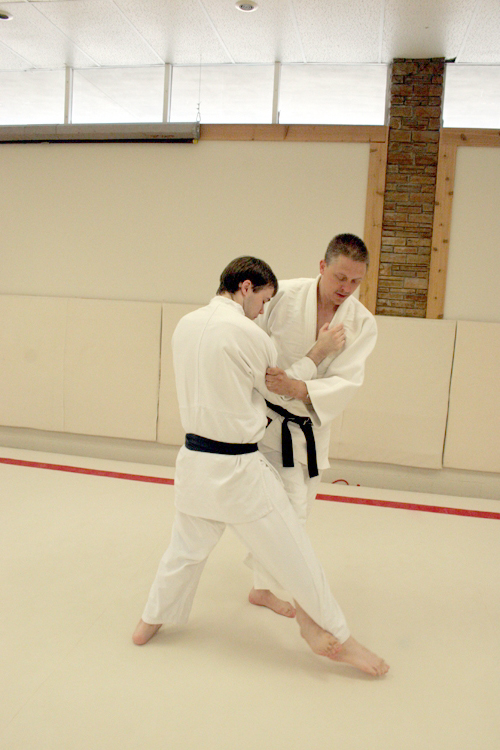
Anybody who has read a book about Judo can tell you there are three phases to a Judo throw: kuzushi (off balance), tsukuri (fitting) and kake (throwing). Now, tell me what you know about these three things. Three of the biggest principles in Judo, and even Kano’s Kodokan Judo manages four entire paragraphs on the subject without really telling us a damn thing.
Where does each phase start? Where does each phase end? What’s going on in each phase?
Now, read that again. Think about. How much do you really know about the subject? Because unless you can actually tell me about it, you haven’t spent time studying it. Yeah, there’s some cerebral stuff in Judo too.
Well, until about 1998 I knew as much as every other book reading Judoka. I had the great fortune of meeting a master Judoka named Rick Pollard, though everyone calls him Moose. Moose had stopped by and was giving us a lesson when he popped that question. “What are the three parts of a Judo throw?” The sound of the fans moving the hot air in the dojo was all there was to be heard. After a lengthy silence, I answered “kuzushi, tsukuri, and kake.”
“Good. You been readin’ your books. But what do you know about ’em?”
“Ummmm…….”
Here’s the lesson:
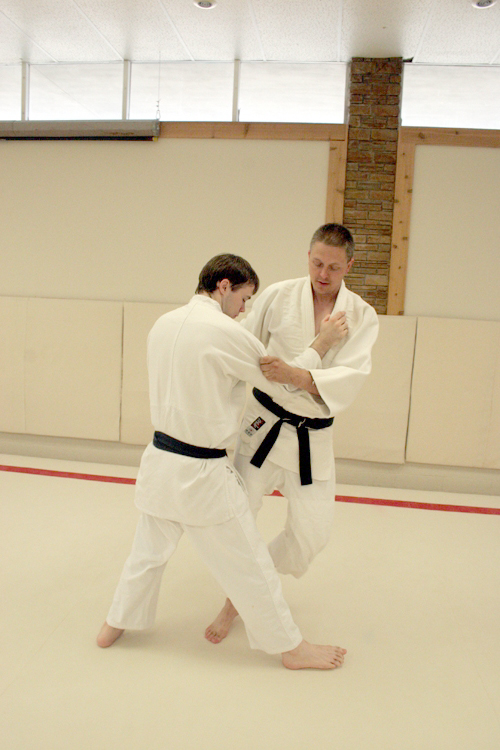
- Kuzushi starts when you do something that causes your opponent to take a step that he would not normally have taken, to give you a moment in time to gain entry. For example, using your collar hand grip to pull uke’s shoulder in front of his foot, causing him to step.
- Kuzushi ends when we start to make our entry, or start tsukuri.
- Tsukuri stops at the execution point of the throw, at the point where we have gained control.
- Kake begins at the point when you have control.
- Kake ends when your opponent is on the ground.
Now, take a minute and read that a few times. Don’t worry — I’ll wait.
After you learn the basics of your throwing, you set about to start applying throws in a random fashion. In other words, you have no agenda, nothing in mind when you go into the encounter. Your only interest is on kuzushi.
Then, something happens. There’s an opening. Do you seize it, or let it pass by? If you seize it, what lives there? What throws are in that neighborhood? Are your feet right to do this throw, or that throw, or some other throw?
Things move entirely too fast for the conscious head to be involved whatsoever. These decisions are being made as a reflexive response to stimuli, and this brings us back to finding out how solid your foundation is. It also tells you what you need to work on. You may find throws coming out that you don’t practice regularly, or throws you never practice on your off side. That’s fine.
How long does it take to achieve this level of play? YEARS. There are no shortcuts friend. Get on the mat, take your falls and have some joyful practice.