Aikido: Ground Self Defense Part 2

by Kyle Sloan; Cameron Siemens, Uke; Photography & Video by Rob Goodwill
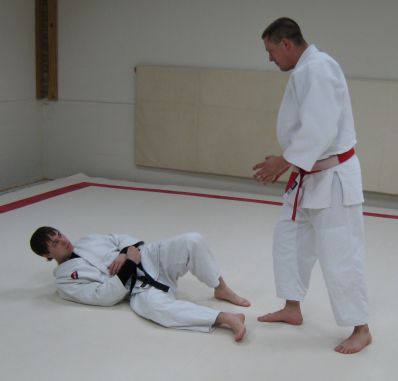
Building on movement from last time, we add a partner to the mix. Using your walking, keep uke lined up in your center line. Begin by having your partner walk around you in a circle, well outside the range of your legs. As you gain skill in moving, have your partner change directions randomly. You’ll find that your partner can jog on the outside of the circle and you’ll have no trouble keeping up.
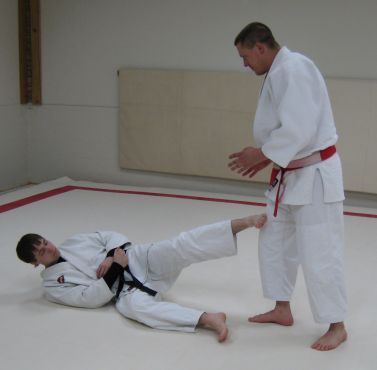
If uke is going to attack, he must close. Don’t extend your legs reaching for him, because your action will have little to no effect.
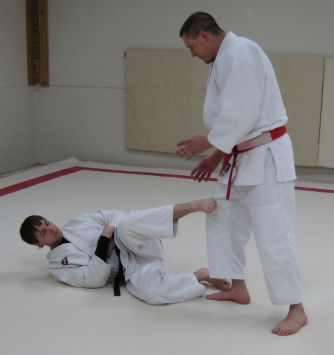
Instead, keep the legs somewhat bent. As uke closes, target the knee of his advanced leg. Use your foot sideways, parallel to the floor. If your foot is vertical there’s a high chance it will slip off to one side or the other.
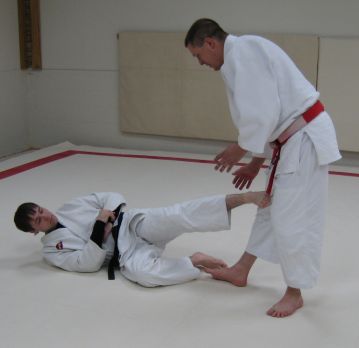
SLOWLY & GENTLY straighten your leg. This will lock uke’s knee.
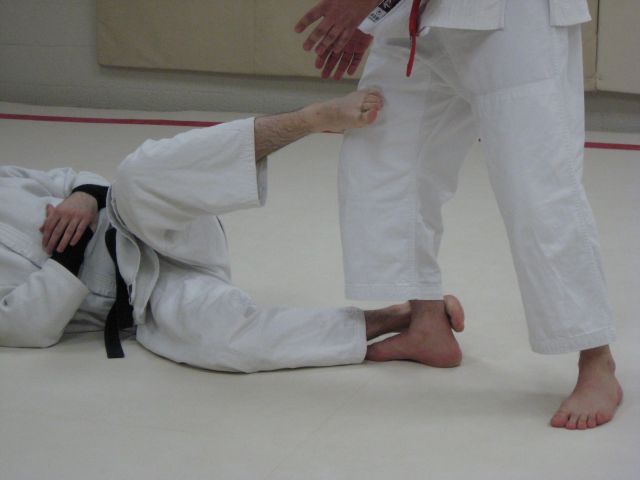
You may use your bottom foot to trap the ankle. When you push with the top leg, pull with the bottom leg. You can trap with your toes…
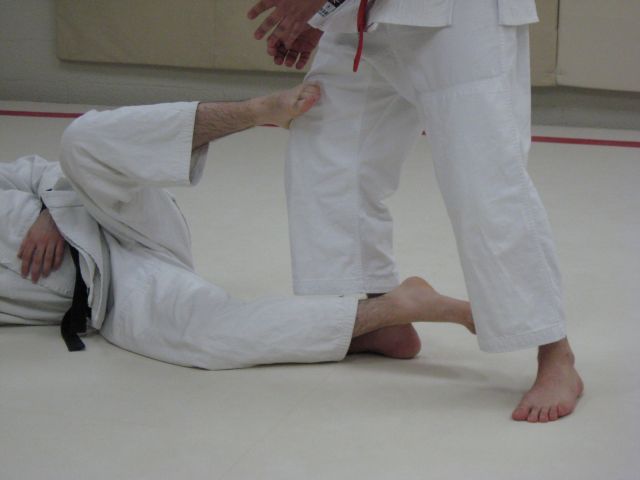
…or with your heel
Similar Posts

  • | | |

    Gravity Assist & Structure Assist in Aikido

    by Kitty Sullivan Learn to use gravity and structure to assist with effective aikido kuzushi / off-balance As long as you are not floating around in space, you are probably attached to a very large spherical body. Therefore you are fortunate enough to utilize its very own gravity when being attacked by another human. Getting…

  • | |

    How to Play Judo

    by Kyle Sloan Some folks might look at what we’re doing, and because it’s not a competition deal immediately dislike it. Well, let me try to change your mind. The method we use for the bulk of our teaching time is a non-resistive uke. This allows for the purest transmission of information between partners —…

  • | | | |

    Teaching: Dependence and Empowerment

    by Nick Lowry I have known teachers who over teach – they are helpful and giving — serve everything up on silver platters but who consequently have built very dependent students. Such are popular teachers; their students will love them and feel confident that they have “learned” and that they “know the subject”. But there…